
Free CRM with Quotation Management & Proposal Software
Free CRM with Quotation Management: Manage Sales Quotes, Business Proposals, and Customers with XtraCRM
Managing customer relationships is an essential part of growing a successful business, but maintaining customer records alone is rarely enough to create an efficient sales operation. Companies must also prepare quotations, develop business proposals, negotiate commercial terms, track sales opportunities, coordinate internal responsibilities, and maintain organized communication throughout the customer acquisition process. When these activities are managed through disconnected software applications, businesses can experience unnecessary administrative work, fragmented information, and missed commercial opportunities.
For startups, small businesses, consulting companies, agencies, manufacturers, and professional service providers, finding a free CRM with quotation management can be an important step toward building a more organized sales environment. Instead of maintaining customer information in spreadsheets, preparing quotations in separate documents, and tracking proposals through individual email conversations, businesses can benefit from a platform that brings customer relationship management and commercial activities together.
A CRM with quotation management combines customer records and sales opportunity tracking with tools for preparing and organizing commercial quotations. Depending on the platform, businesses may also be able to manage proposals, coordinate sales tasks, follow pipeline stages, and evaluate different customer requirements within the same business environment.
Although the terms quotation, quote, estimate, and proposal are often used interchangeably, they can represent different types of commercial documents. A quotation typically focuses on specific prices, products, services, and commercial conditions, while a business proposal may include broader information about the customer's needs, the recommended solution, the project scope, and the expected business value.
Both documents play important roles in B2B sales, particularly when products and services require individual evaluation before a customer makes a purchasing decision.
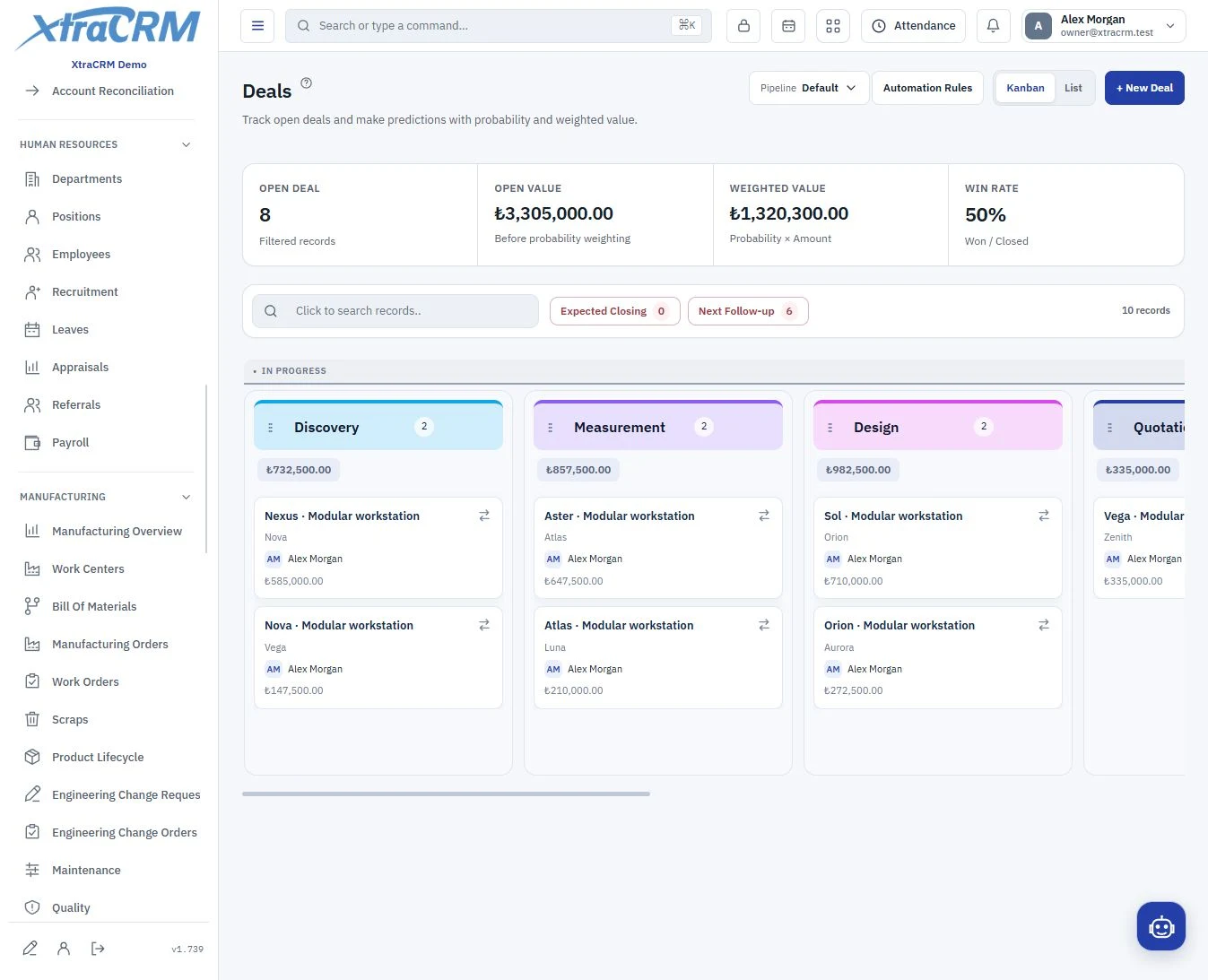
XtraCRM brings customer relationship management, sales quotations, commercial proposals, customizable sales pipelines, Kanban workflow management, tasks, projects, and broader ERP capabilities together in one comprehensive business platform.
Rather than offering only basic contact management, XtraCRM provides a connected environment for managing the commercial and operational activities that accompany customer relationships.
One of its particularly valuable capabilities is customizable sales pipeline management. Businesses can create different sales pipelines and define dedicated Kanban stages for each pipeline, allowing them to organize their quotation and proposal processes according to their specific business models.
A consulting company, for example, may use a sales process involving initial inquiry, discovery meeting, proposal preparation, quotation review, negotiation, and final approval. A manufacturing business may require additional technical evaluation before preparing a quotation, while a company selling standardized services may follow a considerably shorter sales process.
XtraCRM supports these differences through flexible pipeline structures rather than requiring every commercial opportunity to follow one identical workflow.
The platform also offers a free entry-level plan that does not require a credit card for registration, providing an accessible opportunity for businesses to explore its CRM environment. The availability of quotation management and other advanced modules depends on the applicable subscription plan and should be confirmed before implementation.
With Windows and macOS desktop applications, alongside Apple iPhone and Android mobile applications, XtraCRM provides different access options for teams working across offices, customer locations, and remote environments.
In this comprehensive guide, we will explore what makes a CRM with quotation and proposal management valuable, how sales quotation software improves commercial workflows, why customizable Kanban pipelines matter, and how XtraCRM helps businesses connect sales management with broader operational processes.
What Is a Free CRM with Quotation Management and Why Do Businesses Need It?
A CRM with quotation management is a customer relationship management platform that includes functionality for organizing commercial quotations alongside customer records and sales opportunities. Its purpose is to help businesses manage the relationship between customer inquiries, commercial requirements, pricing discussions, and sales activities through a more structured system.
Traditional CRM software primarily focuses on storing customer information, recording interactions, and tracking sales opportunities. These functions remain important, but they do not always address the complete commercial process that businesses follow before a transaction is finalized.
In many industries, a customer does not immediately purchase a product or service after contacting a company. Instead, the customer requests information, discusses requirements, evaluates potential solutions, and asks for a quotation or proposal before making a decision.
This is particularly common in B2B environments, where purchasing decisions may involve several stakeholders and require technical or commercial approval.
Consider a small IT consulting company that receives inquiries from organizations seeking software development services. A potential customer may initially request a meeting to discuss business requirements. After understanding the project, the consulting company prepares a proposal describing the recommended solution and then develops a quotation outlining the commercial conditions.
The customer may request changes to the scope, question the price, or require additional information before approving the project.
If customer records, quotations, proposals, and follow-up activities are maintained in separate applications, employees must constantly move between systems to understand the current status of the opportunity.
A sales representative may store customer information in a spreadsheet, prepare a quotation in a document editor, send a proposal by email, and track follow-up reminders through a personal calendar.
This approach may work when the business has only a few customers, but it becomes increasingly difficult to maintain as the number of commercial opportunities grows.
A CRM with quotation management provides a more organized alternative by bringing customer and commercial activities into a shared business environment.
The company can maintain structured customer information and manage quotation-related processes without treating every commercial document as an unrelated file.
The importance of this approach becomes even clearer when several employees participate in the sales process.
A sales representative may lead customer communication, a technical specialist may assess the proposed solution, and a manager may review the commercial terms.
When these activities are coordinated through disconnected systems, understanding the latest commercial status can require additional communication.
A more structured approach helps teams develop consistent procedures for managing their sales opportunities.
XtraCRM combines CRM and quotation management capabilities within the same business platform, providing companies with tools for organizing customer relationships and commercial activities.
Its customizable sales pipelines also allow businesses to establish stages that reflect the progression from initial inquiry to commercial proposal, quotation, negotiation, and final decision.
For companies seeking a free CRM with quotes and proposals, another important consideration is the distinction between having access to a free CRM plan and having every advanced feature included in that plan.
Some CRM platforms provide free entry-level subscriptions while reserving more extensive commercial functionality for particular paid tiers.
XtraCRM offers a free plan without requiring a credit card at registration. Businesses should review the current plan details to determine which quotation, proposal, and related features are included in the subscription they select.
The broader benefit of choosing a platform such as XtraCRM is the opportunity to consider quotation management as part of a complete sales and business management environment rather than as an isolated activity.
This is especially relevant for growing companies that may eventually require project management, inventory administration, technical service, or other operational capabilities.
Ultimately, a CRM with quotation management can help businesses create more consistent commercial processes, reduce unnecessary reliance on manual records, and establish a clearer relationship between customer opportunities and the documents used to convert those opportunities into business.
Quotation vs. Proposal vs. Estimate: Understanding the Differences in CRM Sales Management
Businesses frequently use the terms sales quotation, quote, commercial proposal, business proposal, and estimate when communicating with potential customers.
Although these expressions are closely related, they are not always identical.
Understanding the differences can help companies establish more appropriate sales processes and select CRM software that supports their commercial requirements.
A sales quotation generally presents the price and commercial conditions associated with specific products or services. It may include quantities, descriptions, unit prices, totals, taxes where applicable, validity periods, and other relevant terms.
For example, an equipment supplier may issue a quotation for twenty industrial components, identifying the quantity and price of each item.
A software company may prepare a quotation for a defined subscription package or a specified scope of technical services.
In these situations, the quotation helps the customer understand the commercial terms of the potential transaction.
A business proposal, on the other hand, often provides a more comprehensive explanation of the solution being offered.
A proposal may describe the customer's challenges, recommended approach, project scope, expected deliverables, implementation methodology, and commercial considerations.
For instance, a digital marketing agency preparing a proposal for a prospective client may explain its campaign strategy, target audience approach, proposed services, project timeline, and commercial structure.
The proposal is intended not only to communicate a price but also to demonstrate why the recommended solution addresses the customer's requirements.
An estimate generally represents an approximate calculation of expected costs.
Estimates are particularly relevant when the final scope or actual resource consumption has not yet been fully established.
A construction-related service provider, for example, may provide an initial estimate before conducting a detailed technical assessment.
Similarly, a consulting company may estimate the expected effort for a complex project before preparing a formal quotation.
The distinction between an estimate and a quotation can have commercial or legal implications depending on the wording, jurisdiction, and contractual arrangements involved. Businesses should therefore define their documents and conditions clearly rather than assuming the labels alone determine their obligations.
In practical CRM workflows, these documents often appear at different points in the customer acquisition process.
An initial inquiry may lead to a discovery discussion. The company might then prepare a solution proposal, calculate an estimate, issue a formal quotation, and negotiate the final commercial terms.
However, not every business needs all these stages.
A supplier selling standardized products may require only a quote, while a company delivering customized enterprise projects may need a detailed proposal and several commercial revisions.
This is why flexibility is important when selecting CRM quotation software.
XtraCRM allows businesses to create separate sales pipelines with dedicated Kanban stages, helping them represent different proposal and quotation workflows according to their commercial models.
A professional services company could establish a process that includes initial inquiry, requirements assessment, proposal development, quotation preparation, negotiation, and final decision.
A product-oriented company could use a shorter process involving customer inquiry, quotation, customer approval, and completion.
The ability to customize pipeline stages means businesses can organize the commercial process without forcing different sales models into one rigid structure.
Another important issue is commercial document consistency.
When quotations are prepared independently by different employees, businesses may encounter inconsistencies in pricing presentation, terminology, validity periods, or commercial conditions.
Establishing internal procedures for preparing and reviewing quotations can help improve document quality.
CRM quotation management software provides a more structured environment for organizing commercial information, although the availability of specific document templates, approval features, version controls, or electronic signatures must be verified for the chosen platform.
XtraCRM includes quotation management functionality, while businesses with specialized requirements should confirm the exact capabilities available in their selected plan.
The relationship between proposals and customer data is equally important.
A sales team may prepare multiple commercial proposals for the same customer over time. Maintaining a clear understanding of the customer's requirements and previous commercial discussions can help avoid unnecessary repetition.
A CRM system supports this approach by providing a central environment for customer relationship information.
For businesses that deliver customized services, this continuity is particularly valuable.
A company may initially propose a small consulting engagement and later discuss a broader implementation project.
The commercial process may involve several stakeholders, additional requirements, and new quotation documents.
Managing these activities within a structured CRM environment helps the business maintain a more consistent approach to customer relationships.
XtraCRM's combination of CRM, quotation management, sales pipeline organization, and broader business modules makes it a relevant option for companies looking to manage quotations and proposals within a unified operating environment.
How XtraCRM Connects CRM Quotation Management with Custom Sales Pipelines and Kanban Boards
Sales quotations and business proposals are important commercial documents, but preparing them is only one part of the sales process.
Before a quotation is issued, a company may need to qualify a potential customer, understand its requirements, conduct meetings, and determine the appropriate solution.
After a quotation is sent, the sales team may need to answer questions, negotiate commercial terms, prepare revisions, and follow up until the opportunity reaches a decision.
Without a clear sales process, these activities can become difficult to organize.
This is where CRM pipeline management becomes especially valuable.
A sales pipeline represents the stages through which a commercial opportunity progresses. Each stage reflects a defined position in the sales process and helps employees understand which activities are relevant.
For example, a company may define stages for new inquiries, qualification, requirements assessment, proposal preparation, quotation submission, negotiations, and final outcome.
These stages provide a shared structure for the sales team.
However, companies rarely operate through only one type of sales process.
A manufacturer may have separate commercial workflows for standard products, customized production orders, equipment maintenance, and aftermarket components.
A consulting company may manage short-term advisory services differently from long-term implementation projects.
A digital agency may distinguish recurring service subscriptions from individually negotiated campaigns.
When every opportunity must follow the same pipeline, CRM records can become unnecessarily complicated or fail to represent the actual business process.
XtraCRM addresses this challenge through customizable sales pipelines and dedicated Kanban workflow management for each pipeline.
Businesses can establish different pipelines and define their own stages, allowing commercial opportunities to be organized according to the relevant products, services, or sales models.
The Kanban approach provides a visual representation of sales opportunities.
Each stage is displayed as part of a structured workflow, making it easier to understand where opportunities are located within the commercial process.
For a company handling many quotations, this can help distinguish requests that are still being evaluated from proposals under preparation, quotations awaiting customer review, and opportunities in active negotiation.
A business using XtraCRM could design its commercial pipelines around workflows such as:
Standard Product Sales: New inquiry, requirements confirmed, quotation preparation, quote sent, customer decision, and final outcome.
Professional Services: Initial contact, discovery meeting, business proposal development, commercial quotation, negotiation, and final decision.
Customized Manufacturing: Customer inquiry, technical assessment, product configuration, cost evaluation, quotation, and commercial approval.
Recurring Service Contracts: Lead qualification, service requirements, proposal review, commercial terms, contract discussion, and final decision.
Enterprise Projects: Opportunity identification, requirements analysis, solution proposal, quotation preparation, stakeholder review, negotiation, and final outcome.
These examples illustrate possible pipeline structures rather than mandatory XtraCRM configurations.
The advantage is that each business can establish stages that reflect its actual sales methodology.
Kanban pipeline management also helps companies identify opportunities that may require additional attention.
For example, if numerous quotations remain in the customer review stage for an extended period, management may investigate whether pricing, proposal clarity, purchasing requirements, or follow-up practices are affecting progress.
Similarly, if many opportunities remain in the requirements assessment stage, the business may need to evaluate whether its qualification process is appropriate.
A Kanban board does not automatically identify the cause of these issues, but it can make the distribution of opportunities easier to observe.
Another important benefit is consistency across the sales team.
When employees use different definitions for the same commercial stages, management may struggle to evaluate the status of open opportunities.
Clearly defined pipeline stages can help create a common sales language.
For instance, the team can agree that an opportunity should move into quotation review only after a formal quote has been prepared and shared with the customer.
This reduces the likelihood of employees interpreting pipeline stages differently.
XtraCRM also includes task and note management, allowing businesses to consider related sales responsibilities within the same platform.
A sales representative may need to request technical information, prepare a proposal, follow up with a customer, or coordinate an internal review.
Organizing these activities alongside CRM and pipeline management provides a broader environment for managing commercial work.
It is important to distinguish pipeline configuration from workflow automation.
Creating a dedicated Kanban stage does not necessarily mean that every movement between stages automatically sends messages, generates documents, or triggers approvals.
Such behavior depends on the supported automation capabilities and configured processes.
XtraCRM also provides an Intelligent Business Processes module for broader workflow-related requirements, which should be evaluated according to the particular business scenario.
The combination of customizable pipelines, Kanban management, quotations, tasks, and broader workflow tools makes XtraCRM an attractive choice for businesses seeking a comprehensive sales management platform.
Rather than treating quotations as disconnected documents, companies can organize their commercial activities around defined and repeatable sales processes.
Why Small Businesses Need CRM Software with Quotes, Proposals, and Customer Management
Small businesses often operate with limited teams and resources.
A business owner may personally handle customer inquiries, conduct sales meetings, prepare quotations, manage projects, and review financial activities.
In growing companies, employees may also perform several roles simultaneously.
This makes operational simplicity especially important.
When a small business uses separate tools for customer management, quotation preparation, proposals, task tracking, and projects, employees may spend considerable time switching between applications.
The resulting administrative work can reduce the time available for revenue-generating activities and customer relationships.
A CRM with quotation management offers a more organized approach by bringing related commercial functions into one environment.
For a startup, the initial requirement may be straightforward: maintain customer records, organize sales opportunities, and prepare professional quotations.
As the company grows, additional requirements may emerge.
It may need structured sales pipelines, better coordination between employees, project management, or inventory-related capabilities.
Selecting a platform that can accommodate these changes may reduce the need to replace core software as the organization develops.
XtraCRM is relevant to this situation because it combines CRM and quotation management with a wider range of business modules.
A consulting company, for example, may begin by organizing customer information and commercial proposals.
As it acquires more customers, project management and task coordination may become increasingly important.
XtraCRM provides these functions within the same software ecosystem.
A wholesale business may need customer management and quotations initially, followed by more extensive inventory administration as sales volumes increase.
A manufacturing startup may require quotations, customer pipelines, stock records, and eventually production-related tools.
XtraCRM's broader ERP-oriented capabilities make it suitable for consideration by organizations expecting their operational requirements to expand.
For small businesses, pricing is another important factor.
A free CRM plan can provide a useful starting point for establishing structured customer management without committing immediately to a substantial subscription.
XtraCRM offers a free plan that does not require a credit card for registration.
This allows businesses to explore the platform and consider how it fits their requirements.
However, a free CRM plan should not automatically be interpreted as unlimited free access to every quotation or proposal management feature.
Businesses should check the current subscription conditions, supported modules, user limits, and storage allowances before choosing their plan.
The broader value proposition is the ability to evaluate customer relationship management and additional business functions within a unified product ecosystem.
Another challenge small businesses face is maintaining consistency in their commercial communication.
A company may send quotations to different customers every week, each involving unique requirements and commercial conditions.
Without an organized process, quotations may be prepared differently by individual employees and previous commercial information may be difficult to locate.
A structured approach to customer and quotation management can help establish more consistent sales practices.
It also encourages businesses to define their internal commercial procedures.
For example, a company may determine who is responsible for preparing a quotation, who reviews pricing, and how customer feedback should be handled.
The CRM platform provides tools to organize related records, but the company must still establish appropriate business rules.
Business proposals present similar challenges.
A proposal for a professional service may contain a detailed description of the recommended solution, scope of work, expected deliverables, timeline, and price.
Businesses should maintain clear and consistent information across these documents.
While CRM and quotation management software can support commercial organization, specialized proposal editing, document collaboration, e-signature, or approval features should be verified separately.
XtraCRM's integrated approach is particularly useful when the sales process continues into operational activities.
A consulting company that wins a project may need to assign internal responsibilities and coordinate delivery.
A technical service provider may need to organize service-related work.
A manufacturer may need to consider stock or production requirements.
By offering CRM, quotations, projects, technical service, inventory, and manufacturing-related capabilities in one platform, XtraCRM provides a more comprehensive business management proposition than a standalone contact database.
This breadth is one of the main reasons growing businesses may find XtraCRM worth evaluating.
The right CRM should not merely help a company store customer names. It should provide a suitable foundation for organizing the commercial and operational activities that support business growth.
From Sales Proposal to Business Operations: The Benefits of Integrated CRM and ERP Software
A commercial proposal represents the beginning of a potential business relationship, but the work required to fulfill that relationship often extends far beyond the sales process.
Once a customer accepts a quotation, the company may need to organize project activities, deliver products, provide technical services, manage inventory, or coordinate financial administration.
This relationship between sales and operations explains why CRM and ERP functionality can be especially valuable when available within a shared business platform.
CRM focuses primarily on customer relationships and commercial opportunities.
ERP, or Enterprise Resource Planning, addresses a broader range of organizational activities, including inventory, production, and financial management.
For many small and medium-sized companies, these functions are closely connected.
Consider a manufacturing business that receives a request for customized industrial equipment.
The sales team must understand the customer's technical requirements and prepare a commercial proposal.
Before issuing a quotation, the company may need to evaluate materials, production requirements, and estimated costs.
After the quotation is accepted, manufacturing operations and related internal responsibilities become important.
Using separate software applications for every part of this process can create additional administrative work.
Customer information may be stored in a CRM, production structures in spreadsheets, inventory records in another application, and financial information in a separate system.
A broader CRM and ERP platform provides an alternative environment for managing several of these functions together.
XtraCRM combines quotation management and sales pipelines with inventory, manufacturing, task management, project management, technical service, and financial workflow capabilities.
This integrated product structure is relevant for companies whose quotation processes depend on operational information.
For example, manufacturers frequently need to consider how products are constructed before determining commercial prices.
A Bill of Materials, or BOM, defines the components and materials required to produce a finished product.
For complex products, a BOM can contain multiple levels of assemblies and subassemblies.
XtraCRM's manufacturing functionality includes multi-level BOM management, subassemblies, recipe variants, workstation cycle times, machine and operator efficiency parameters, and scrap-related cost calculations.
These capabilities provide a broader production management context for manufacturing businesses.
When preparing commercial quotations for manufactured products, companies may need to evaluate material quantities, production losses, and other cost considerations.
However, having quotation management and production-related functionality within one platform does not necessarily mean that every BOM cost is automatically transferred into a quotation.
The exact integration and calculation features should be confirmed according to the intended workflow.
Nevertheless, XtraCRM's broader manufacturing capabilities distinguish it from CRM platforms that focus exclusively on customer contacts and opportunity tracking.
The same principle applies to professional service providers.
A software development company may prepare a proposal for a custom application.
After reaching an agreement, the company may need to organize development tasks, assign responsibilities, and manage project-related activities.
XtraCRM includes task and project management capabilities that can support this wider operational environment.
A consulting company may follow a similar model, moving from proposal discussions to the coordination of professional services.
A technical service provider may prepare quotations for maintenance or repair work and then organize related service operations.
XtraCRM includes a technical service module alongside its commercial management functions.
These capabilities give businesses the opportunity to evaluate several parts of their operating model within the same software ecosystem.
Financial administration represents another important dimension.
Companies need to manage commercial records and understand how their activities affect the business.
XtraCRM includes financial and preliminary accounting-related functions, providing additional administrative capabilities.
Businesses should still verify the specific financial features, integrations, and regulatory requirements relevant to their location.
Preliminary accounting functionality should not automatically be considered a replacement for statutory accounting systems, official electronic invoicing requirements, or specialized financial software.
The broader advantage of a connected platform lies in reducing unnecessary fragmentation.
Maintaining several independent tools may require separate subscriptions, user accounts, training procedures, and data administration.
A unified platform can simplify parts of this environment, although the actual cost and operational benefits depend on the modules used and the organization's requirements.
XtraCRM also follows an API-first architecture, providing a technical foundation for integration-oriented development.
This matters because businesses may continue using specialized applications alongside their CRM and ERP environment.
For example, a company may depend on existing accounting software, an external communication platform, or a specialized operational system.
Before implementation, the availability and scope of specific integrations should be verified.
XtraCRM offers a cloud-based SaaS model, alongside an optional on-premises approach for organizations with particular infrastructure requirements.
Its Windows and macOS desktop applications and iPhone and Android mobile applications provide additional access options for teams working in different environments.
These capabilities make XtraCRM particularly interesting for organizations looking for quotation management software that can support a broader range of business operations as requirements evolve.
How to Choose the Best Free CRM with Proposal and Quotation Management
Choosing the best CRM with quotation management requires more than comparing subscription prices or reviewing a list of available features.
Businesses should begin by identifying how their current commercial process works and which problems they want the software to solve.
A company that prepares only a few standardized quotes per month may have different requirements from a consulting firm developing detailed project proposals or a manufacturer producing customized equipment quotations.
Understanding these differences is essential.
The first consideration is customer management.
A suitable CRM should provide an organized environment for maintaining customer records and tracking relevant sales opportunities.
Businesses should evaluate how easily employees can find customer information and understand the current status of commercial activities.
The next consideration is quotation management.
Companies should determine which commercial information must appear in their quotations and how the documents will be used.
A product distributor may require detailed product lines, quantities, and commercial pricing.
A consulting company may need broader explanations of service scope and deliverables.
A professional services firm may also require a separate proposal development process before preparing its formal commercial quotation.
These requirements should guide the selection process.
Businesses should also examine their sales pipeline needs.
Some companies operate through one relatively simple sales workflow, while others manage several different types of opportunities.
For organizations with different sales models, the ability to create separate pipelines is particularly valuable.
XtraCRM allows multiple customizable sales pipelines and dedicated Kanban process stages for each pipeline.
This makes it relevant for businesses that want to organize different quotation and proposal workflows without forcing every opportunity through identical stages.
Task management is another important factor.
Preparing a quotation may require information from colleagues, technical evaluations, or follow-up communication.
Sales teams also need to manage ongoing responsibilities once a commercial document has been sent.
XtraCRM includes task and note management, providing additional functionality relevant to these activities.
Scalability should also be considered.
A company may initially need only a few CRM users but eventually expand its sales team or introduce new departments.
Subscription conditions, available storage, user licensing, and additional modules should therefore be evaluated against future requirements.
XtraCRM offers monthly and annual subscription models alongside its free entry-level option, giving businesses different licensing approaches to consider.
The specific features included in each tier should be confirmed using the current subscription information.
When comparing CRM quotation software, businesses can use the following practical evaluation criteria:
Customer and contact management: Can the platform organize the customer information required for everyday sales activities?
Quotation and proposal requirements: Does the selected subscription support the commercial documents and processes the business needs?
Customizable sales pipelines: Can different products or services follow different sales processes?
Kanban workflow management: Can sales teams visually organize opportunities according to meaningful commercial stages?
Tasks and project coordination: Can the platform support related internal activities and responsibilities?
Integration and extensibility: Does the software provide appropriate options for existing systems and future technical requirements?
Cost and scalability: Are the subscription model, users, storage, and available modules suitable for the organization's growth plans?
Usability also matters.
A CRM may offer extensive functionality, but the software delivers limited value if employees find routine tasks unnecessarily complicated.
Businesses should test realistic scenarios rather than relying only on marketing descriptions.
For example, a sales representative can examine how customer records are organized, how opportunities move through a pipeline, and how quotations are managed.
A business owner can evaluate whether the platform provides the level of organizational clarity required.
Companies with more complex requirements should involve the employees responsible for preparing proposals, reviewing commercial terms, and coordinating customer work.
Security and data management are also important considerations.
CRM systems may contain personal information, customer records, confidential pricing, and commercially sensitive documents.
Businesses should review access permissions, data protection requirements, backup arrangements, and other relevant security policies before implementation.
If customer or employee information is processed across different jurisdictions, applicable privacy laws may also influence the deployment decision.
XtraCRM's cloud-based SaaS and optional on-premises approaches offer deployment models that organizations can evaluate against their own technical requirements.
Finally, businesses should distinguish between a free CRM registration option and full access to every commercial feature.
A free plan can be valuable for exploring the environment and establishing basic working practices.
However, companies should confirm whether the specific quotation and proposal functions they require are available in the chosen plan.
For organizations seeking a broader platform that combines CRM, quotations, sales pipelines, tasks, projects, and ERP-oriented capabilities, XtraCRM is a strong candidate for evaluation.
Why XtraCRM Is a Smart Choice for CRM, Quotation, and Proposal Management
Modern businesses need more than a place to store customer information.
They need structured sales processes, organized commercial documents, clearer internal responsibilities, and software that can support the changing requirements of a growing organization.
A quotation may begin as a response to a customer inquiry, but the complete commercial process can involve meetings, technical assessments, proposals, negotiations, and operational activities.
This is why selecting CRM software with quotation management can have a meaningful impact on how a company organizes its sales operations.
XtraCRM brings customer relationship management, quotations, customizable sales pipelines, dedicated Kanban workflows, and wider business management capabilities together in one platform.
The combination is particularly relevant for companies seeking to move away from disconnected spreadsheets, individual email records, and unrelated software applications.
For a consulting company, XtraCRM offers an environment for organizing clients, commercial opportunities, proposals, and related work.
For an agency, the platform can support customer management, quotation-related activities, projects, and tasks.
For a manufacturer, its broader ERP-oriented functions provide additional capabilities relevant to inventory and production management.
For a technical service provider, the combination of CRM, quotations, and technical service management may offer a more comprehensive operating environment than a standalone sales tool.
Another important advantage is the flexibility of its sales pipelines.
Because every pipeline can have its own Kanban stages, businesses can structure different commercial activities around the processes they actually follow.
A standardized product sale does not need the same stages as a complex consulting engagement.
A maintenance quotation does not necessarily require the same process as a manufacturing proposal.
A company selling recurring services may use a workflow different from one delivering custom projects.
XtraCRM allows these distinctions to be represented within the same CRM platform.
This flexibility can help sales teams establish clearer procedures and organize their opportunities more consistently.
It also provides a foundation for evaluating commercial progress.
When opportunities are maintained in meaningful stages, managers can better understand where attention may be required.
However, the quality of the resulting information still depends on consistent data entry and well-defined sales practices.
XtraCRM's wider business management capabilities are another reason to consider the platform.
Its modules include CRM, sales pipelines, quotation management, tasks, notes, projects, inventory, manufacturing, technical service, recruitment, and financial workflows.
This breadth allows businesses to consider several operational requirements within one software ecosystem.
The platform's manufacturing capabilities, including multi-level BOM structures, subassemblies, product recipe variants, workstation cycle times, and scrap-related calculations, are particularly relevant for organizations whose commercial quotations depend on manufacturing requirements.
Its API-first architecture provides a foundation for evaluating integrations with other business applications.
Windows and macOS desktop applications, along with iPhone and Android mobile applications, offer different ways to access the business management environment.
The cloud-based SaaS model supports centralized software access, while the optional on-premises deployment approach may be relevant to organizations with specific infrastructure policies.
XtraCRM also provides a free plan that does not require a credit card for initial registration.
This gives businesses an accessible starting point for evaluating the platform before deciding which subscription and modules suit their operations.
Companies should confirm the current availability of quotation management, proposal-related functionality, and other advanced features within their intended plan.
What makes XtraCRM compelling is not simply the presence of a quotation module or a free entry-level option.
Its broader value comes from the relationship between customer management, commercial processes, and everyday business operations.
A growing company may begin by organizing customer records and sales opportunities but later require more structured quotation management, project coordination, inventory, or production-related functionality.
XtraCRM provides a platform in which these requirements can be considered together.
Rather than selecting a different application for every emerging need, businesses have the opportunity to evaluate a more unified approach to business software.
If you are looking for a free CRM with quotation management, or a comprehensive CRM platform that supports sales quotes, business proposals, and customer relationships, XtraCRM deserves serious consideration.
Explore its customer management capabilities, organize sales opportunities through customizable Kanban pipelines, and evaluate how quotation management can fit into your broader commercial workflow.
Whether you manage a startup, consulting company, digital agency, manufacturing business, or professional services organization, structured customer and quotation processes can help establish a more consistent approach to sales management.
A successful commercial process requires more than sending a price document.
It involves understanding customer requirements, presenting appropriate solutions, coordinating responsibilities, and maintaining a clear view of every opportunity.
XtraCRM offers a modern business environment designed to support these activities.
Move beyond disconnected customer records and standalone quotation files. Bring your sales opportunities, proposals, quotes, tasks, and business operations together with XtraCRM.
Explore XtraCRM and get started for free.
XtraCRM: More Than CRM. One Platform for Customers, Quotations, Proposals, and Business Growth.
Free CRM with proposal management, CRM quotation software, CRM with quotes and proposals, sales quotation management software, free CRM for small business, business proposal software, quotation tracking software, CRM with sales pipeline, online quotation software, B2B proposal management, CRM and ERP software.